Data Collection & Linkage

Data Collection

The A3BC collects longitudinal, real‑world data alongside biological samples to understand disease patterns, treatment response and long‑term outcomes in arthritis and autoimmune disease.

Data collection is designed to complement routine care and minimise burden on participants, while enabling high‑quality, life‑course research that cannot be achieved through short‑term clinical trials alone.

What data are collected?

Depending on consent and study participation, A3BC may collect the following types of data.

Patient‑reported outcomes

  • Symptoms, disease activity, function, fatigue and quality of life
  • Physical, mental and social wellbeing
  • Lifestyle, diet and environmental exposures

Clinical data

  • Diagnosis and disease characteristics
  • Treatments and medication history
  • Disease activity, flares, damage and outcomes

Case Report Form (CRF) data

  • Structured clinical assessments collected by treating teams at key timepoints
  • Includes validated classification criteria, physical examination findings and disease‑specific activity measures

Biospecimen‑related data

  • Sample type, collection timepoint, processing and storage metadata
  • Recorded using internationally recognised pre‑analytical standards

To ensure data quality and consistency, A3BC uses a minimum dataset, developed in line with international best practice for observational cohort studies in rheumatology.

Standardised clinical assessments (clinician‑reported)

A3BC uses internationally recognised clinical scoring systems and classification criteria, selected according to diagnosis.

Examples include:

  • ACR/EULAR 2010 Classification Criteria (Rheumatoid arthritis)
  • CASPAR Criteria (Psoriatic arthritis)
  • ASAS / Modified New York Criteria (Axial spondyloarthritis)
  • ILAR Criteria (Juvenile idiopathic arthritis)
  • EULAR/ACR Criteria (Vasculitis, Myositis, Sjögren’s syndrome)

Disease activity, severity and damage assessments include (where clinically relevant):

  • DAS28 (CRP/ESR), DAPSA – RA and PsA
  • ASDAS, BASDAI, BASMI – Spondyloarthritis
  • JADAS / cJADAS – JIA
  • BVAS and Vasculitis Damage Index – Vasculitis
  • SLEDAI‑2K, Easy‑BILAG – SLE and connective tissue disease
  • CMAS, MMT‑8, Myositis Damage Index – Myositis (adult and paediatric)

Clinical measures are collected at baseline and selected follow‑up timepoints, aligned with routine care where possible.

Patient‑reported questionnaires (registry data)

A3BC and ARAD collect validated patient‑reported outcome measures across adults, adolescents and children. Instrument selection varies by age, diagnosis and consent.

Core quality‑of‑life and function measures

  • RAPID‑3
  • PROMIS‑29 v2.1 (adult)
  • PROMIS‑25 (paediatric)
  • EQ‑5D‑5L / EQ‑5D‑Y
  • CHU‑9D (self and proxy)
  • CHAQ (paediatric function)

Disease‑specific impact measures

  • RA‑FQ, RADAI – Rheumatoid arthritis and inflammatory arthritis
  • BASDAI / ASDAS – Spondyloarthritis
  • PsAID‑9 – Psoriatic arthritis
  • PMR‑IS, GCA‑PRO – PMR and GCA
  • AAV‑PRO – ANCA‑associated vasculitis
  • GAQ 2.0 – Gout
  • FACIT‑Fatigue – Fatigue impact

Lifestyle, exposures and social factors

  • Smoking, vaping and alcohol use
  • Physical activity and exercise
  • Diet and nutrition (selected timepoints)
  • Occupational history, shift work and UV exposure
  • Education, employment and work productivity

Psychosocial and adherence measures

  • Three‑Item Loneliness Scale
  • Single‑Item Literacy Screener (SILS)
  • Compliance Questionnaire for Rheumatology (CQR‑5)

When is data collected?

For participants in the A3BC registry:

  • Baseline (0 months)
  • 6, 12, 18 and 24 months
  • Annually thereafter, for the life of the project

Additional data collections may occur when clinically meaningful events arise, such as:

  • Disease flares
  • Treatment initiation, tapering, switching or stopping
  • Surgery or biopsy
  • Participation in approved sub‑studies or partner clinical trials

Data collection schedules do not reset when therapies change, unless specified within an approved project.

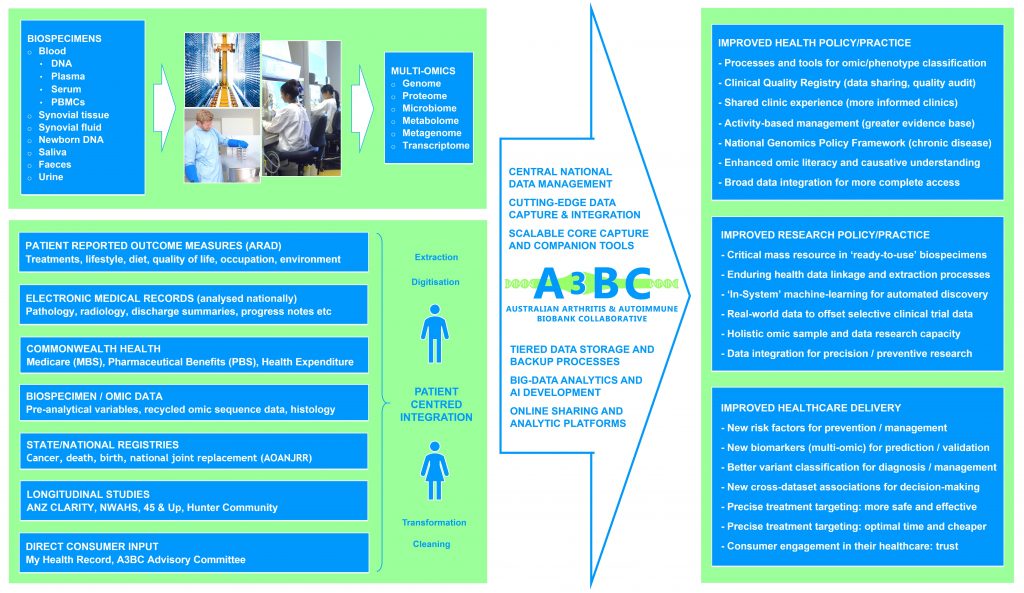
Data Linkage

With participant consent, A3BC links data from multiple health and research sources to build a more complete picture of health over time. Linked data are used only for ethics‑approved research and are managed within secure research environments.

Linked datasets may include

Australian Rheumatology Association Database (ARAD)

  • Longitudinal patient‑reported outcome and experience data

Hospital and clinic electronic medical records (EMR)

  • Data from participating public and private hospitals, clinics and pathology services
  • Blood test results, clinical and discharge notes, treatment outcomes and medical imaging (e.g. X‑ray, MRI, CT)

Specialist clinic data

  • Information recorded by treating rheumatologists and other relevant clinicians

State and national health datasets

(accessed via approved data‑linkage infrastructure, including Services Australia, AIHW and related platforms)

  • Medicare Benefits Schedule (MBS) claims
  • Pharmaceutical Benefits Scheme (PBS) claims
  • Australian Immunisation Register (AIR)
  • Aged Care Services data
  • National Disability Insurance Scheme (NDIS) data
  • Hospital admissions, outpatient and emergency department data
  • Cancer and death registries
  • Serious notifiable conditions

My Health Record (participant‑controlled)

  • Diagnoses, medications, allergies and prescribing information
  • Medical imaging and pathology summaries
  • Access occurs only if the participant chooses to enable it

Research‑derived data

Genomic, transcriptomic, proteomic, metabolomic or microbiome data generated through approved use of A3BC samples

Privacy, security and governance

All data are handled in accordance with:

  • National ethical guidelines
  • State and Commonwealth privacy legislation
  • A3BC governance and access frameworks

Data are de‑identified wherever possible. Identifiable information is stored securely and accessed only by authorised personnel for approved purposes such as data linkage or participant follow‑up.

Participants choose which data collections and linkages they consent to and may withdraw at any time.